

What will AI-powered shopping look like? Glami and Biano join forces and test new answers


Michala Gregorová
(Press Release) Two leading Czech search engines from Miton's portfolio, fashion-focused Glami and furniture-focused Biano, are entering a new chapter. As of March 2026, both companies are led by a single CEO, Peter Hupka, who previously headed Biano. Both companies hold normalized data on millions of products data that large language models lack and aim to build on this foundation to develop a new generation of online product discovery tools.


Glami and Biano together aggregate products from thousands of e-shops across Europe. Their core work lies in data normalization, as every e-shop delivers product information in a different structure. Both companies have been tackling this normalization challenge for years, and it is now becoming a competitive advantage at a time when chatbots and AI assistants are running into exactly this problem: a lack of structured, up-to-date product data at scale.
Both companies have been experimenting with new AI features for two years, and entirely new products are being developed. They draw on both their unique data assets and dedicated ML/AI teams — the one at Glami, led by Antonín Hoskovec, was established as early as 2018.
AI Guider: What a Product Catalogue Could Look Like in 2026
The first concrete outcome of this direction is an AI guide currently being tested in the robotic lawnmower category. Instead of browsing hundreds of listings, users enter their requirements and the system progressively refines its recommendations. This is a pilot project designed to demonstrate what the shopping experience can look like when structured product data is combined with AI capabilities. If successful, both companies plan to roll out a similar approach across additional categories.
Spin-offs: Densy Has Its First Paying Users, Dyllz App Goes Live
Alongside developing their own AI tools, both companies are supporting projects built on their data and expertise.
- Densy, an interior design platform in which Biano invested €200,000 last year, now has over 4,000 registered users and its first paying customers. E-shops are beginning to showcase their products directly to designers on the platform.
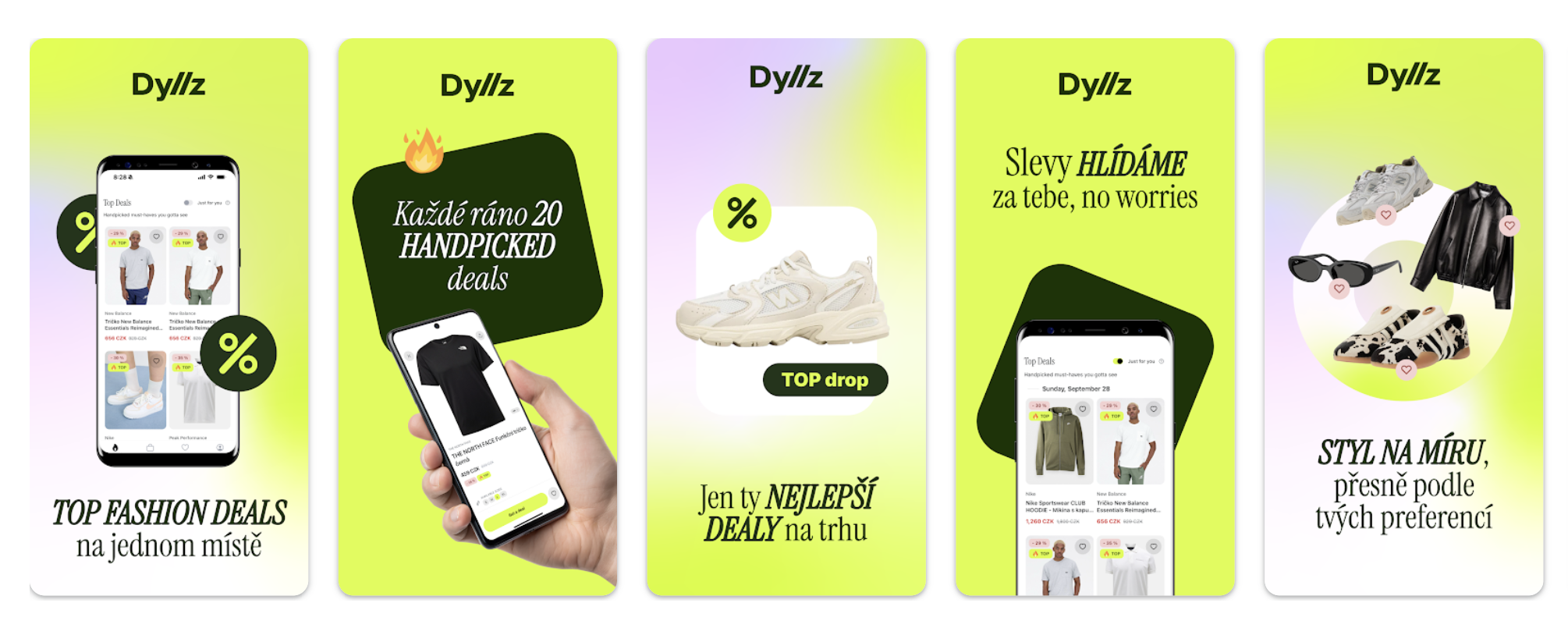
- Dyllz, an app focused on the best fashion discount deals — created on the Glami side — has surpassed 15,000 downloads and is processing its first orders.
Further projects are currently running in stealth mode.


Not only these projects were set in motion thanks to the work of former CEO Ján Kešelák. Peter Hupka's appointment is the result of a long-planned, mutually agreed transition that allows for a smooth continuation of what Ján Kešelák and his team put in place. "Jánko's 8-year track record at Glami includes expansion into new countries that are now central to Glami's business, the acquisition and integration of the Stileo team, and the major AI adoption the entire company went through over the past year," says Miton partner and Glami founder Tomáš Hodboď. "Jánko deserves great credit for where Glami is today, and he remains on board as a shareholder and active supporter. We are also discussing new opportunities in AI, including at the Miton level," he adds.
One Company, Two Brands, Faster Learning
Glami and Biano remain separate brands with their own teams. The changes have a clear rationale: so that solutions tested by one company do not need to be reinvented by the other. One example is automatic product tagging, which Glami is gradually rolling out and Biano will follow. Both companies also face the same challenges, such as competing with Google and Temu, and the transition to AI engineering.
New CEO of both companies Peter Hupka is not starting from scratch at Glami. Before joining Biano, he worked there himself in business development and expansion into new markets, and the two companies have long had a close relationship.
"Fashion and furniture are still largely searched for visually, but they are also categories where highly parametric search plays a key role. That is where I see the future of both companies: helping customers find the perfect piece while still leaving room for inspiration. Our experience with individual solutions also allows us to create spin-offs that tackle more specific problems in depth. AI gives us unprecedented agility — Densy, for instance, is currently run by just two people, and user feedback has been exceptionally positive. Similarly, the Dyllz app, which was built by essentially two people, already has over 15,000 downloads," says Peter Hupka.
"The challenge the entire market is now grappling with — how to become more efficient internally through AI — is one we already worked through last year. That allows us to focus on the opportunities AI brings on the product side. The way people shop online is changing faster than ever before, and both Glami and Biano have the data and the position to be part of that shift," concludes Tomáš Hodboď.


Glami is the largest fashion search engine in Europe, visited each month by tens of millions of users across 14 countries. It aggregates products from thousands of e-shops and helps users discover fashion that matches their taste. Glami is part of the portfolio of investment group Miton. The Glami Story
Biano is a furniture and home goods comparison platform operating in 10 European countries. It connects users with products from hundreds of e-shops and uses its own AI and machine learning to recommend relevant items. Biano is also part of the portfolio of investment group Miton.
Share


Of further interest


What happened: Fall/Winter 2025
The second half of the year, like the whole year (and the two previous ones as well), was marked by AI. This year will be no different. There will be a lot of AI in this summary too. But we’ll also add a bit of crypto and psychedelics.


PangeAI emerges from stealth to democratize access to geospatial data
(press release) A startup founded by Johanna von der Leyen and Marek Miltner at Stanford is changing the way companies and public institutions work with geospatial data. Instead of needing to hire a team of GIS experts, PangeAI agents allow making complex analyses and decisions involving physical infrastructure as easy as typing a prompt. The goal is to make the physical world as searchable and understandable as the digital one.


Every company wants to become more efficient thanks to AI, and almost none succeed. Miton is investing €400k into a startup that wants to fix this.
(press release) Even though companies know very well that AI can significantly increase their efficiency, most never get further than paying for ChatGPT accounts for their employees. It’s not motivation they lack - most fail in the implementation phase. The problem lies in the approach companies take: they treat AI as if it were traditional software. And this is exactly where Bandits comes in, a new project by Jiří Štěpánek, Kryštof Mitka and Miton.